@logician/log-core
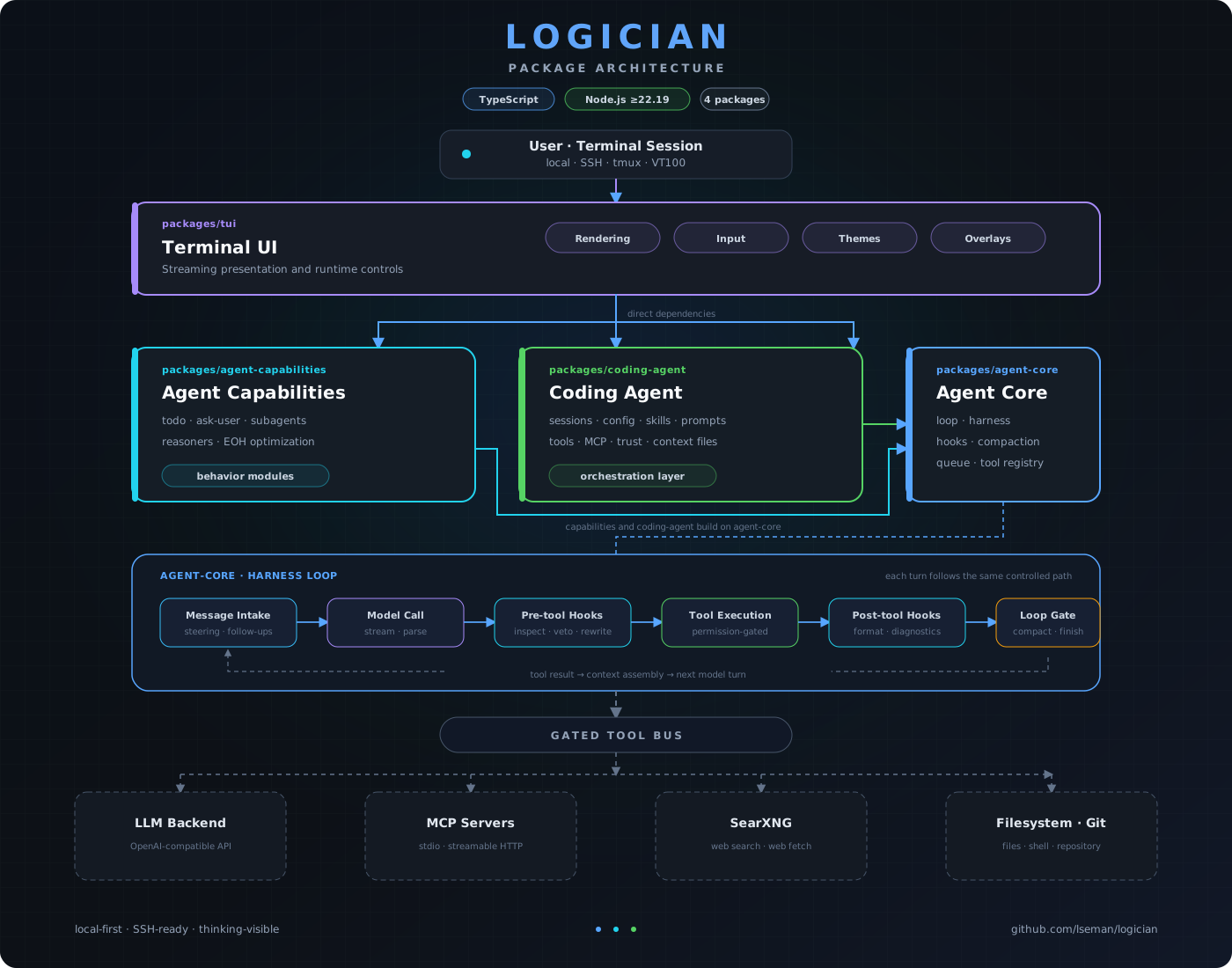
Lean agent engine: loop, harness, hooks, compaction, tool
registry — plus the versioned client protocol, since log-protocol
merged into this package. Zero internal dependencies — the sole foundation.
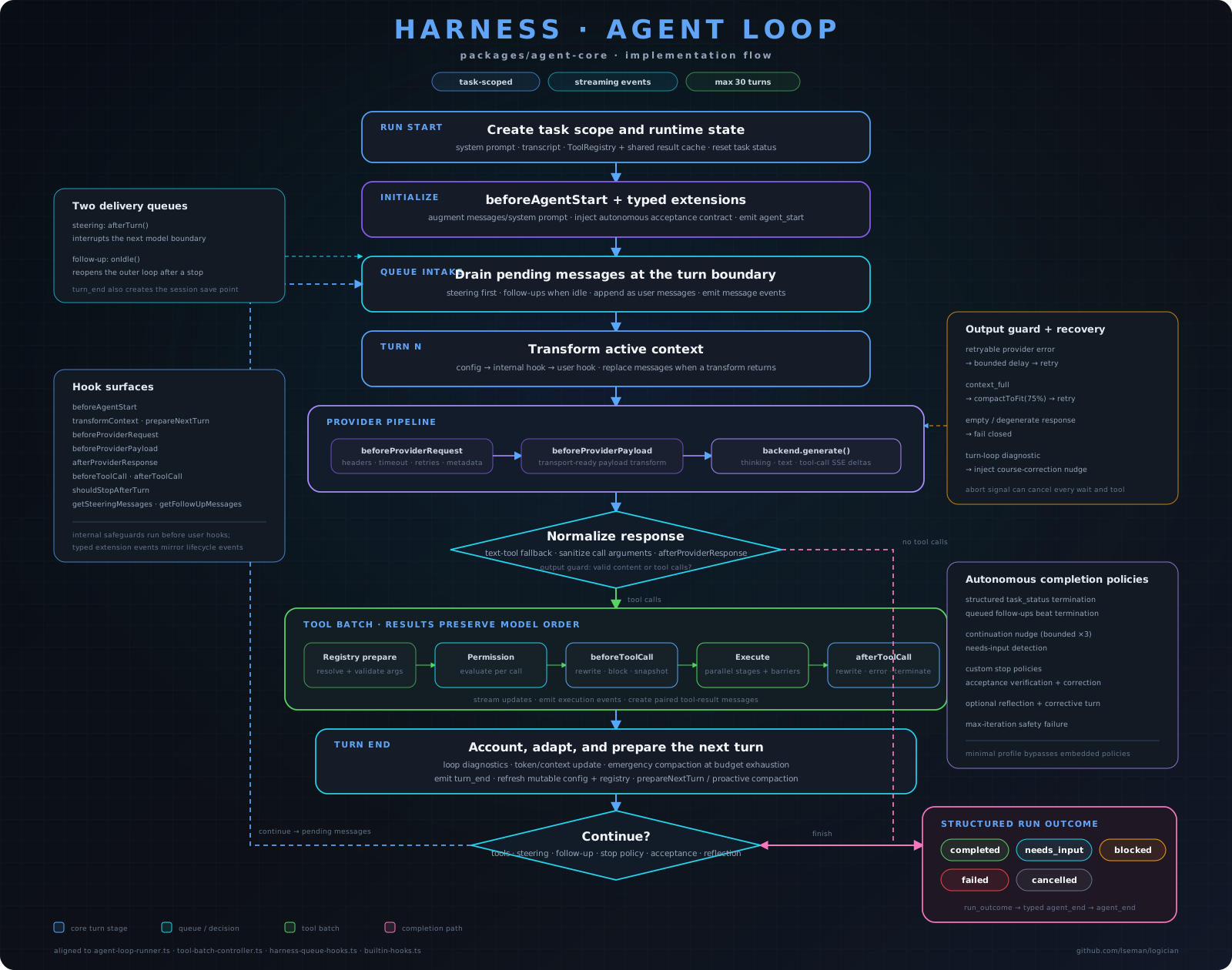
runtime/harness and runtime/execution drive the turn
loop: intake → model call → tool execution → hooks → next turn.runtime/hooks — pre/post-tool hook chains, budget tracking, hook
metrics.runtime/compaction — context compaction, run checkpoints, and
recovery when a session approaches its token budget.capabilities/session — the append-only thread ledger, file
checkpoints, and cloud-sync exclusion markers.capabilities/tools — permissions, tool-call parsing, the tool
registry.control/ — guards and policy that enforce the loop; system/types
holds the pure vocabulary (budgets, task ledger, acceptance config) both sides
share without a circular dependency.system/types/types-protocol — the versioned, UI-ready notification
envelopes every runtime and client speaks; internal provider, hook, and tool
events are translated before crossing this seam.- Backend abstraction over any OpenAI-compatible API, with typed, retryable
errors.
@logician/log-runtime
Composes log-core into a running agent and hosts
every optional capability, one folder per capability under capabilities/.
The only package that depends on every other feature package, including all four
under packages/.
capabilities/reasoning/ — SSR, Tree of Thoughts, Graph of Thoughts,
Reflexion, Best-of-N, Self-Consistency, Auto-CoT, In-Context CoT, plus a shared
base and registry.capabilities/delegation/ — subagent spawning and definitions.capabilities/tasks/ — todo tracking with status transitions.capabilities/ask/ — structured prompts back to the user
mid-turn.capabilities/rag/ — retrieval-backed tools, the one place this
package depends on @logician/log-rag.capabilities/tools/ — the built-in tool registry, assembling tools
from every capability above.capabilities/memory/, lsp/, mcp/,
skills/, interactions/, extensions/ — the
remaining capability seams.runtime/ — the orchestration layer on top: agent bridge, tool
router, session/transcript handling, configuration.- Wires in
@logician/log-eoh as one more opt-in capability.
@logician/log-eoh
(packages/log-eoh)
Evolution of Heuristics (arXiv 2401.02051) — a standalone
evolutionary optimization engine.
- Population management, evaluator, and compaction for evolving heuristics across
generations.
- Own session logic, persistence, and dashboard.
- Depends only on
log-core; wired in by log-runtime as
one more capability. Opt-in, not on the critical path.
@logician/log-autoresearch
(packages/log-autoresearch)
Measured experiment loops: run, evaluate, keep or discard against
a baseline.
- Depends only on
log-core to drive experiment trials.
- Ported from
pi-autoresearch; used for reproducible improvement
loops rather than one-off runs.
@logician/log-memory
(packages/log-memory)
Persistent, SQLite-backed memory. Stands alone — no internal
@logician/* dependencies.
- Observation capture, consolidation, and lexical + semantic retrieval.
- Context injection back into the agent loop.
- Exposed to any MCP client via
@logician/log-memory-mcp
(apps/log-memory-mcp), independent of the TUI.
@logician/log-rag
(packages/log-rag)
Hybrid retrieval. Stands alone — consumed by
log-runtime, not the other way around.
- Dense + BM25 hybrid search with structural chunking and cross-encoder
reranking.
- Query rewriting, source attribution, and context budgeting.
@logician/log-eval
Outcome-grounded evaluation runner for agent trials. Stands
alone.
- Treats repository state and executable checks as authoritative.
- An agent's own completion claim is retained only as diagnostic evidence, never
as the pass/fail signal.
@logician/tui
(apps/tui)
The terminal UI. Streams model output, tool traces, and reasoning
live to any VT100-compatible terminal — local, SSH, or tmux. Depends directly on
log-core, log-runtime, blocks/log-autoresearch,
and blocks/log-memory.
layers/presentation — rendering pipeline.layers/input — keybindings, input bar, steering queue.layers/theme — theme system, theme selector.layers/events / layers/core — event plumbing, TUI core
state machine.components/ — status bar, transcript display, MCP manager, reasoner
selector, EOH panel, popups/overlays.- Entry point handles
exec and doctor CLI modes before
booting the interactive TUI.